

Continuous water temperature monitoring for Legionella prevention: what to measure and how it works
Legionella prevention in buildings relies largely on keeping hot water hot and cold water cold across the whole installation. Manual readings with a thermometer show one moment at a few points. Continuous monitoring with wireless probes shows every hour at the points that matter, and raises an alert when a temperature drifts.
What to measure and where
- Tank outlet: the temperature the hot water leaves the tank or calorifier with. If it is low here, it will be low everywhere.
- Return loop: the water coming back to the tank shows how much the circuit loses and whether recirculation works.
- Far taps and showers: the end points of each branch, where the water arrives coolest and stands longest.
- Cold water: inlet, storage tanks and risers, especially where cold pipes run close to hot ones or through warm spaces.
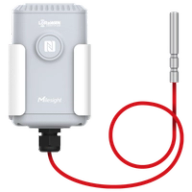
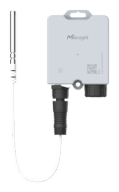
The probes are fixed to the pipe or fitted at the outlet, and the wireless sensor sends each reading to the platform. Which points and thresholds to use is decided by whoever runs the building's water management.
Why continuous records instead of manual readings
- Nothing in between: a manual round misses what happens at night, at weekends or between visits. A continuous record does not.
- No copying: readings are stored with time and location automatically, without sheets to fill in or type up.
- History at hand: when someone asks for the temperatures of a point last month, you export them in a few clicks.
Alerts when a temperature drifts
Set a threshold per point: an alert when hot water falls below the value you choose or cold water rises above it. Each alert can go by email, SMS, WhatsApp, voice call or push notification in the iOS and Android app, to the people you choose for each building.
Regulation and the water management program
In the United States, Legionella prevention in buildings is organized through water management programs, such as those based on ASHRAE 188, and temperature control is one of the measures they usually include. Continuous temperature records help the team document those controls. The program itself, its control points and limits, and any water treatment or sampling remain the responsibility of the building owner and their water management team.
The platform monitors temperatures and stores their history. It does not treat water, take samples or make a building compliant on its own.
Who installs it and how many buildings fit
Usually the building's maintenance company or an installer fits the probes and the gateway; the sensors run on batteries and need no new cabling. Maintenance companies see all their buildings on one map, each with its alerts and history, and can offer the service to their clients under their own brand with the white-label option.
The platform runs on AWS (Frankfurt for Europe, United States for the rest of the world) or on your own servers. Sensors connect through LoRaWAN network servers such as The Things Stack, LORIOT, ThingPark X, ChirpStack or Helium, and other equipment can send data over MQTT or HTTP.