IoT Platform
LoRaWAN networks for IoT: from sensor to platform
Devices
Gateways
Network Server

Devices
Gateways
Network Server
CS GearLong-range, low-power wireless connectivity for massive IoT deployments. Discover how LoRaWAN is transforming industries worldwide — and how Cloud Studio's CS Gear platform makes it easy to deploy.
What is LoRaWAN?
LoRaWAN (Long Range Wide Area Network) is an open-standard protocol designed to wirelessly connect battery-powered IoT devices to the internet over long distances. Built on LoRa radio modulation technology by Semtech, it enables thousands of sensors to transmit small data packets across 2–15 km in urban areas and up to 20 km in rural environments — all while running on a single battery for 5 to 10 years. Managed by the LoRa Alliance, LoRaWAN has become the world's most widely adopted LPWAN protocol, powering networks in over 170 countries.
LoRa (Physical Layer)
Chirp spread spectrum radio modulation by Semtech that enables ultra-long-range communication with minimal power consumption.
LoRaWAN (Network Protocol)
Open-standard MAC layer protocol managed by the LoRa Alliance. Handles device authentication, encryption, and data routing from sensors to applications.

Star-of-Stars Topology
Devices communicate with multiple gateways that forward data to a central network server. This redundancy ensures reliability even if a gateway fails.
LoRa vs LoRaWAN: What's the Difference?
Understanding the distinction between LoRa and LoRaWAN is essential for making informed decisions about your IoT connectivity architecture.
LoRaWANProtocol
AES-128OTAAADRStar topology
builds on top of
LoRaPhysical layer
CSSSF7-SF12868/915 MHz
| LoRa | LoRaWAN | |
|---|---|---|
| Type | Physical layer (radio) | Network protocol (MAC) |
| Created by | Semtech (proprietary) | LoRa Alliance (open standard) |
| Modulation | Chirp Spread Spectrum (CSS) | ALOHA-based MAC protocol |
| Security | None built-in | AES-128 dual-layer encryption |
| Topology | Point-to-point | Star-of-stars (managed) |
| Device management | Manual / custom | OTAA, ADR, MAC commands |
| Scalability | Limited (manual) | 1,000-10,000+ devices/gateway |
Think of it this way: LoRa is to LoRaWAN what a WiFi radio chip is to the WiFi protocol (IEEE 802.11). The chip handles the physical transmission, but the protocol makes networking possible. You can use LoRa alone for simple point-to-point links, but the moment you need security, device management, and scalability for production IoT, LoRaWAN is what makes it practical. It is the difference between having a radio and having a network.
How LoRaWAN Works
A LoRaWAN network consists of four key layers that work together to move data from sensors in the field to actionable insights in your application.
End Devices (Nodes)


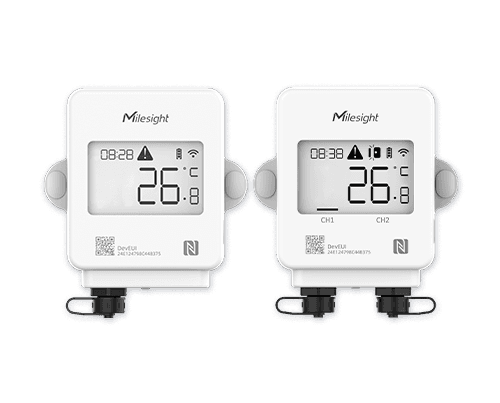
End devices are the sensors, trackers, and actuators that form the edge of a LoRaWAN network. These battery-powered nodes collect data from the physical world and transmit small data packets — called uplinks — to nearby gateways using the LoRa radio modulation. Each uplink typically contains just 10 to 20 bytes of sensor data, keeping transmissions short and energy consumption minimal.
Common LoRaWAN end devices include temperature and humidity sensors for environmental monitoring, GPS trackers for asset and livestock tracking, water meters and flow sensors for utility management, soil moisture probes for precision agriculture, door and window contact sensors for building security, and air quality monitors for smart city applications. Devices operate on low duty cycles, waking briefly to take a reading and transmit, then returning to deep sleep. This approach enables battery lifetimes of 5 to 15 years on a single coin cell or AA battery.
End devices can also receive commands from the network — called downlinks — to update configuration, trigger an actuator, or acknowledge a critical alarm. The timing and availability of downlinks depend on the device class (A, B, or C).
LoRaWAN Device Classes
TX (uplink)
RX (downlink)
Beacon
Listening
Class A is the default and most energy-efficient operating mode in LoRaWAN. Communication is always initiated by the end device: after each uplink transmission, the device opens two short receive windows (RX1 and RX2) during which the network server can send a downlink. Outside these brief windows, the device is in deep sleep, consuming almost no power. This uplink-initiated pattern makes Class A ideal for battery-powered sensors that report data periodically — such as temperature loggers, water meters, and soil moisture probes. It delivers the longest battery life of all three classes and is by far the most widely deployed class in LoRaWAN networks worldwide.
Example devices
Why Choose LoRaWAN for Your IoT Project?
LoRaWAN delivers unmatched advantages for large-scale IoT deployments where cost, coverage, and battery life matter most.
15 km
Long-Range Coverage
A single gateway covers up to 15 km in rural areas and 2–5 km in dense urban environments, drastically reducing infrastructure needs.
10+ yr
Ultra-Low Power Consumption
Sensors operate on coin-cell or AA batteries for 5 to 10+ years, eliminating costly battery replacement visits in the field.
1000+
Massive Scalability
Each gateway supports over 1,000 devices simultaneously. Scale from a pilot of 50 sensors to enterprise deployments of millions incrementally.
80%
Dramatically Lower Costs
No monthly per-device subscriptions when you own the network. Total cost of ownership is 3–5x lower than cellular IoT alternatives at scale.
AES-128
End-to-End Security
AES-128 encryption at both network and application layers. Unique device keys and mutual authentication prevent unauthorized access.
0 fees
Own Your Network
Deploy private LoRaWAN networks without depending on telecom operators. Full control over coverage, data, and security — with zero recurring carrier fees.
LoRaWAN vs. Other IoT Connectivity Technologies
| Feature | LoRaWANRecommended | NB-IoT | Sigfox | LTE-M |
|---|---|---|---|---|
| Range | 2–15 km | 1–10 km | 3–40 km | 1–10 km |
| Battery | 10+ years | 5–8 years | 10+ years | 3–5 years |
| Device Cost | $8–10 | $10–12 | <$5 | $15–20 |
| Subscription | None (private network) | $1–5/year per device | $1–14/year per device | $3–10/year per device |
| Data Rate | 0.3–50 kbps | Up to 250 kbps | ~100 bps | Up to 1 Mbps |
| Private Network |
Technical Specifications
A detailed look at the technical parameters that define LoRaWAN's capabilities as a leading LPWAN technology.
EU868Europe
IN865India
US915Americas
AU915Australia
AS923Asia-Pacific
Frequency Bands
- LoRaWAN operates in unlicensed ISM (Industrial, Scientific, and Medical) frequency bands, which means no spectrum license or recurring fees are required to deploy a network. The specific band varies by region: EU868 (863-870 MHz) is used across Europe, the Middle East, and Africa; US915 (902-928 MHz) covers the Americas; AS923 (923 MHz) is used in Asia-Pacific countries including Japan, Singapore, and Australia; AU915 (915-928 MHz) is the Australian regional plan; IN865 (865-867 MHz) is designated for India; and KR920 (920-923 MHz) covers South Korea.
- Duty cycle regulations vary by region — in Europe, devices are limited to 1% duty cycle on most sub-bands, while US915 uses frequency hopping to comply with FCC regulations. The LoRa Alliance maintains regional parameters documents that specify the exact channel plans, power limits, and regulatory requirements for each region.
SF7
5.47 kbps|2 km
SF8
3.13 kbps|3 km
SF9
1.76 kbps|5 km
SF10
0.98 kbps|8 km
SF11
0.54 kbps|11 km
SF12
0.29 kbps|15 km
SF12: max range, min speedSF7: max speed, min range
Data Rates & Spreading Factors
- LoRaWAN supports a range of data rates determined by the spreading factor (SF) and bandwidth configuration. At SF7 with 125 kHz bandwidth — the fastest setting — devices achieve approximately 5.47 kbps with a maximum payload of 242 bytes, suitable for short-range, high-throughput scenarios.
- At SF12 — the slowest but longest-range setting — the data rate drops to approximately 0.29 kbps with a maximum payload of 51 bytes, enabling communication over distances exceeding 15 km. The Adaptive Data Rate (ADR) algorithm automatically selects the optimal spreading factor for each device based on real-time link quality metrics, ensuring the best balance between range, battery consumption, and airtime.
- For most sensor applications, a typical payload of 10 to 20 bytes is transmitted every 15 minutes to several hours, making even the lowest data rates more than sufficient.
App ServerAppSKey
Only app decrypts payload
AppSKeyAES-128
Application layer
Network Server
Routes & deduplicates
NwkSKeyAES-128
Network layer
Device
Generates both keys via OTAA
AES-128 — End-to-end encryption
Security Architecture
- LoRaWAN implements a robust, multi-layered security architecture designed for IoT environments. Two independent AES-128 encryption layers protect data in transit: the Network Session Key (NwkSKey) secures the communication between the end device and the network server, ensuring packet integrity and preventing replay attacks; the Application Session Key (AppSKey) provides end-to-end encryption of the application payload, so that only the intended application server can decrypt the data — not even the network operator has access.
- Over-the-Air Activation (OTAA) is the recommended provisioning method, where devices perform a secure cryptographic join procedure with a Join Server to derive unique session keys for each connection. This is significantly more secure than Activation by Personalization (ABP), which uses static keys.
- The LoRaWAN 1.1 specification introduced further security enhancements, including a dedicated Join Server for key management and improved handover security. Firmware Over-The-Air (FUOTA) capability enables secure remote firmware updates, ensuring devices can be patched against vulnerabilities without physical access.
| Maximum Range | 15+ km (rural), 2-5 km (urban) |
| Battery Life | 5-15 years (typical sensor duty cycle) |
| Data Rate | 0.29 - 50 kbps |
| Max Payload | 51 - 242 bytes (SF dependent) |
| Frequency Bands | EU868, US915, AS923, AU915, IN865, KR920 |
| Encryption | AES-128 (dual layer: network + application) |
| Devices per Gateway | 1,000 - 10,000+ |
| Modulation | Chirp Spread Spectrum (CSS) |
Real-World Use Cases
LoRaWAN's unique combination of long range, low power, and low cost makes it the ideal connectivity solution for an extraordinary range of IoT applications across industries.


Our Success Stories with LoRaWAN
Real-world deployments powered by Cloud Studio's IoT platform Gear with LoRaWAN.
Our IoT Platform: CS Gear, is connectivity-agnostic and integrates natively with leading LoRaWAN network servers from our partners like The Things Stack, Actility, and LORIOT. Connect any LoRaWAN-certified device, visualize its data in real time, configure native or AI-powered alerts and automations, all from CS Gear.
2000+
Years protected
100%
Coverage area
15+
Sensors deployed
Tarragona, Spain

Protecting 2,000-Year-Old Heritage in Tarragona
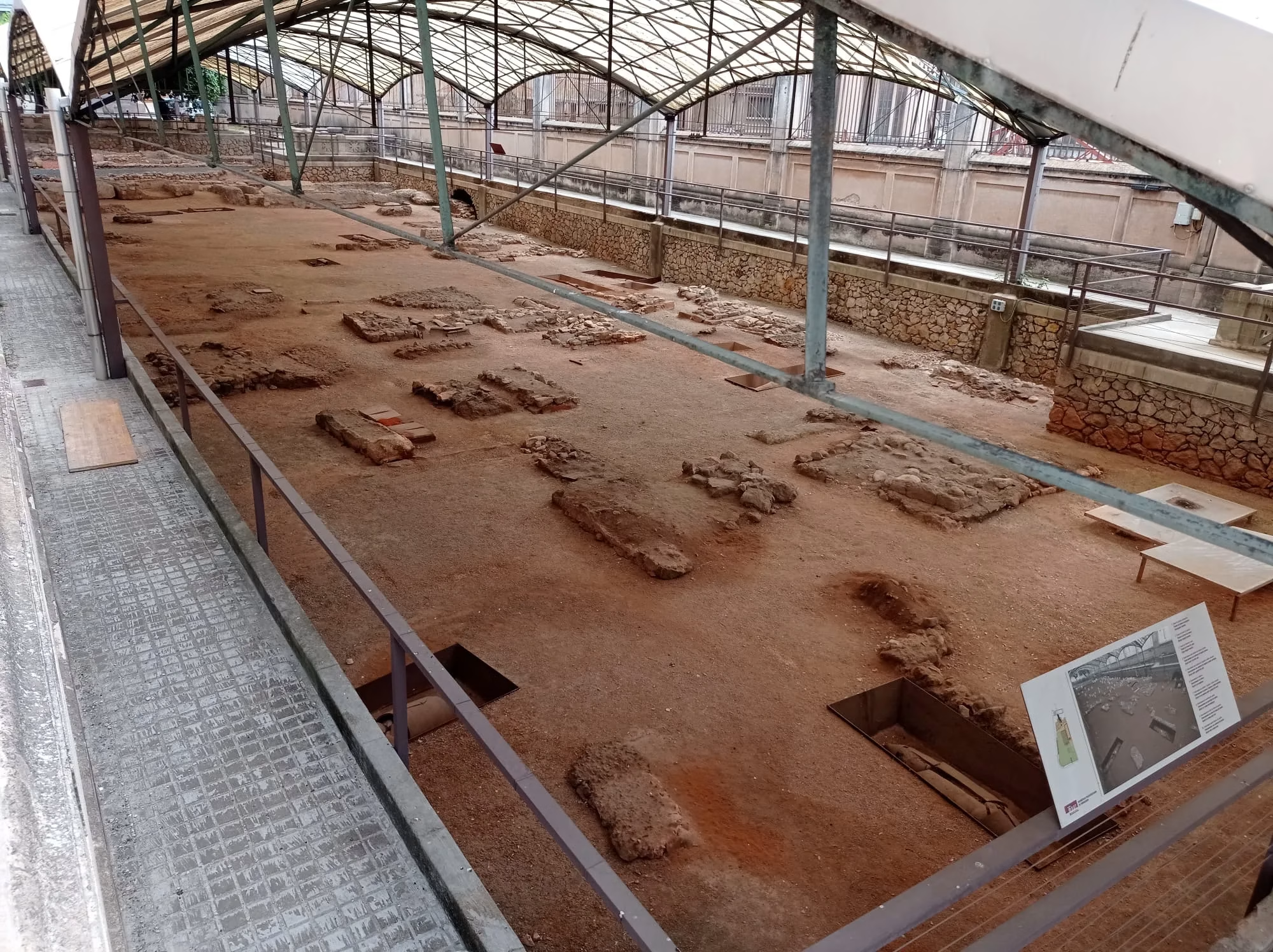
Milesight LoRaWAN sensors monitor temperature, humidity, and structural conditions in Roman archaeological sites, preserving UNESCO-protected heritage with zero wiring needed.
LoRaWAN was the only viable option: running cables through 2,000-year-old Roman ruins was out of the question. The battery-powered Milesight sensors transmit environmental data wirelessly to gateways positioned across the archaeological complex, providing continuous monitoring without any physical intervention to the protected structures.
From the hub
LoRaWAN guides and case studies
Tools and in-depth guides for each part of the topic. Every one links back here for the full picture.
Frequently Asked Questions about LoRaWAN
Everything you need to know before starting your LoRaWAN project.
Ready to deploy?
Deploy LoRaWAN in Your Business
From pilot to production in weeks. Our team will help you plan, deploy, and scale your LoRaWAN network with CS Gear.