




Skip to main content

IoT Solutions for the Era of Industry 4.0

What impact would integrating IoT solutions have on your production?

IoT Solutions for the Era of
50%

Increase in operational efficiency

45%

Reduction in downtime

35%

Energy consumption reduction

40%

Improvement in product quality

30%

Cost reduction overall

25%

Better workforce utilization

Not optional

What the law and the lenders already ask of this kind of installation.

  • Required by lawRoyal Decree 1215/1997 on work equipmentIn force for every employer in Spain.
  • Required by lawRoyal Decree 56/2016, energy auditsEvery four years from the previous audit.
  • Required by lawDirective (EU) 2023/1791 (Energy Efficiency Directive), Article 11First audit by 11 October 2026; energy management system by 11 October 2027.
  • Required by lawRoyal Decree 486/1997 on workplacesIn force for every workplace.
What each rule requires
01
Operational efficiency gain
50%

Operational efficiency gain

02
Downtime reduction
45%

Downtime reduction

03
Overall cost savings
30%

Overall cost savings

Tucumán, Argentina
🇦🇷 Tucumán, Argentina

Success Story

With CALSA

500+

Variables Monitored

40%

Efficiency Gain

24/7

Real-time Monitoring

Smart Factory Transformation
01

Smart Factory Transformation

Traditional factories become fully connected digital operations with IoT platforms.

Data for Digital Twins
02

Data for Digital Twins

Stream live sensor data into virtual replicas of physical assets for simulation and optimization.

Complete Industry 4.0 Solutions

End-to-end digital transformation for manufacturing excellence.

Machine Connectivity

Connect legacy and modern equipment for unified monitoring.

Production Analytics

Real-time visibility into production performance.

Maintenance Alerts

Equipment health monitoring with alarms on abnormal readings.

Quality Control

Real-time monitoring of quality parameters, with alerts when they drift out of range.

Supply Chain Integration

Connect production with supply chain operations.

Regulations and certifications

What is required by law, what lenders and insurers ask for, and what is optional, with how continuous monitoring helps document it. The platform supports compliance; it does not certify it.

Required by law

Rules in force for the buildings and operators in their scope. Not meeting them can bring inspections, fines or loss of a licence.

  • Required by lawSpainLaw

    Royal Decree 1215/1997 on work equipment

    Article 3.5 (maintenance) and article 4 (checks)

    What it requires: Equipment must be maintained following the manufacturer's instructions or, failing those, its conditions of use. Equipment exposed to deterioration that can create danger needs periodic checks, and extra checks after accidents or long stops. The results must be documented, kept available to the labour authority and kept for the whole service life of the equipment.

    Applies: In force for every employer in Spain.

    If it is not met: Breaches are occupational health and safety infractions enforced by the labour inspectorate; the decree itself sets no fine amounts.

    How monitoring helps: A continuous, dated record of vibration, temperature and current per machine, with alerts when a trend points to deterioration and a history to attach to each check. The checks themselves are done by competent staff.

    Official source
  • Required by lawSpainLaw

    Royal Decree 56/2016, energy audits

    Articles 2 and 3; Law 18/2014, articles 80 and 82

    What it requires: Large companies (250 or more employees, or over 50 million euros turnover and 43 million balance sheet) must have an energy audit every four years covering at least 85% of their final energy use, or run a certified energy management system that includes it.

    Applies: Every four years from the previous audit.

    If it is not met: Not doing the audit is a very serious infraction: 10,001 to 60,000 euros. A substandard audit: 1,001 to 10,000 euros.

    How monitoring helps: Sub-metering by site and use gives the auditor measured data for the 85% coverage, and shows four years later what the recommended measures actually saved.

    Official source
  • Required by lawEuropean UnionLaw

    Directive (EU) 2023/1791 (Energy Efficiency Directive), Article 11

    Article 11(1) and (2), energy management systems and audits

    What it requires: Companies that use more than 85 TJ a year (about 23.6 GWh) must run a certified energy management system. Those above 10 TJ (about 2.8 GWh) without one must have an energy audit at least every four years, with an action plan.

    Applies: First audit by 11 October 2026; energy management system by 11 October 2027.

    If it is not met: National penalties that must be effective, proportionate and dissuasive (Article 32).

    How monitoring helps: Sub-metering by site, building and use gives the audit and the energy management system measured data instead of estimates, and shows afterwards whether each measure in the action plan saved what it promised.

    Official source
  • Required by lawSpainLaw

    Royal Decree 486/1997 on workplaces

    Annex III, environmental conditions

    What it requires: Offices and similar sedentary work must stay between 17 and 27 °C (14 to 25 °C for light work), with relative humidity between 30% and 70% and at least 30 m³ of fresh air per hour per worker (50 m³ in other cases). It sets no CO2 limit.

    Applies: In force for every workplace.

    If it is not met: It is an occupational health and safety rule, enforced by the labour inspectorate; the decree itself sets no fine amounts.

    How monitoring helps: Temperature, humidity and CO2 per room, logged continuously, show whether each workspace stays within the ranges and give the prevention service a record when an employee complains.

    Official source
  • Required by lawEuropean UnionLaw

    Regulation (EU) 2023/1230 on machinery

    Annex III, 1.1.9 and 1.2.1; article 18

    What it requires: Connecting another device to a machine, locally or remotely, must not create a hazardous situation. Safety-critical software and data must be protected against corruption, with evidence of interventions kept, and control systems must withstand reasonably foreseeable malicious attempts. Whoever substantially modifies a machine, physically or digitally, becomes its manufacturer.

    Applies: Applies from 14 January 2027 to machinery placed on the market.

    If it is not met: Penalties set by each Member State, which must be effective, proportionate and dissuasive and may be criminal for serious infringements (article 50).

    How monitoring helps: Clamp-on sensors and a gateway that only reads PLC data do not write to safety functions, so monitoring is added without touching how the machine is protected. Whether a change is substantial is decided by the plant's own risk assessment.

    Official source
  • Required by lawEuropean UnionLaw

    Directive (EU) 2022/2555 (NIS2)

    Annex II (manufacturing), article 21 (measures) and article 34 (fines)

    What it requires: Medium and large manufacturers of computers and electronics, electrical equipment, machinery, vehicles and other transport equipment, medical devices, chemicals and industrial food production must manage cybersecurity risk: risk analysis, incident handling, business continuity, supply-chain security, access control and asset management, and an early warning within 24 hours of a significant incident.

    Applies: Applies in the EU since 18 October 2024. Spain's law transposing it was still a bill in November 2026.

    If it is not met: Maximum fines of at least 7 million euros or 1.4% of worldwide turnover for important entities, and 10 million or 2% for essential ones.

    How monitoring helps: An inventory of connected assets, a read-only gateway that only opens outbound connections, and hosting in AWS Frankfurt or on your own servers. We are a supplier you have to assess like any other; the platform does not make anyone NIS2 compliant.

    Official source
  • Required by lawEuropean UnionLaw

    Regulation (EU) 2024/2847 (Cyber Resilience Act)

    Articles 13, 14, 64 and 71; Annex I

    What it requires: Manufacturers of products with digital elements, connected sensors and gateways included, must meet the Annex I cybersecurity requirements and report actively exploited vulnerabilities to the national CSIRT and ENISA.

    Applies: Vulnerability reporting from 11 September 2026; all other obligations from 11 December 2027.

    If it is not met: Up to 15 million euros or 2.5% of worldwide turnover, whichever is higher, for breaching the essential requirements (article 64).

    How monitoring helps: It falls on whoever makes the devices, not on the plant. For the plant it is a question to put to every supplier of connected equipment, us included, before buying.

    Official source
  • Required by lawEuropean UnionLaw

    CSRD (Directive (EU) 2022/2464) as amended by Directive (EU) 2026/470

    Scope after the Omnibus I amendment

    What it requires: Companies above both 450 million euros of net turnover and 1,000 employees must report on sustainability, energy consumption of their buildings included. The amendment removed listed SMEs from scope.

    Applies: Reports for financial years from 1 January 2027; transposition by 19 March 2027.

    If it is not met: National penalties. For tenants and suppliers of these companies it also means being asked for the data.

    How monitoring helps: Measured energy use per building and per tenant, kept as a history, gives the report numbers that can be traced back to a meter.

    Official source

Technical references

Standards and guides that become binding where a regulation or the authority adopts them, and the yardstick an inspector or auditor uses.

  • Technical referenceInternationalStandard

    ISO 20816-3:2026

    Vibration of industrial machines between 120 and 30,000 r/min

    What it requires: Guidance for judging the vibration of industrial machines, measured on non-rotating parts, both by its value and by how much it changes. The zone limits are guidelines, not legal thresholds.

    How monitoring helps: Vibration velocity and temperature per machine, with alarms set on the levels and on the change against each machine's own baseline.

    Official source
  • Technical referenceInternationalStandard

    IEC 62443-3-3

    System security requirements and security levels

    What it requires: The reference for securing industrial automation and control systems: zones and conduits, access control, data integrity and system hardening by security level.

    How monitoring helps: The gateway sits in its own zone, reads from the PLC network and sends outbound only, which keeps the plant network closed to the internet.

    Official source

Voluntary certifications and good practice

Chosen by the owner to prove performance to tenants, users or investors.

  • VoluntarySpainCertification

    Royal Decree 36/2023, Energy Savings Certificates (CAE)

    Article 2; one CAE equals one kWh of final energy saved

    What it requires: Savings from standard measures are calculated with the measure's technical sheet; savings from one-off measures must be confirmed by a savings verifier accredited by ENAC. The certified savings can be sold to the energy companies that have savings obligations.

    Applies: In force since 2023; taking part is up to the plant.

    If it is not met: None: it is a way to turn measured savings into income.

    How monitoring helps: Metered consumption before and after a measure gives the savings file measured data. Verification and issuing the certificates are done by the accredited verifier and the administration.

    Official source
  • VoluntaryInternationalCertification

    ISO 50001:2018

    Energy management systems

    What it requires: An energy policy, a baseline, performance indicators and continual improvement checked by measurement. Under Directive (EU) 2023/1791 it becomes the route for companies above 85 TJ a year, and in Spain it replaces the four-yearly audit.

    How monitoring helps: Measured consumption per line and per large consumer gives the baseline and the indicators the standard asks to track.

    Official source

Industry 4.0 in practice: what a plant has to prove and how to measure it without stopping production

For most factories, Industry 4.0 is not a new production line. It is knowing the condition of the machines and the energy each line uses, with data instead of rounds and spreadsheets. That data has become something the rules ask for: maintenance checks that must be documented, energy audits built on measured data and, from 2027, connected machinery and cybersecurity rules. This guide explains what each rule asks for, which measurement answers it, how to connect what the plant already has and how to start without touching the PLCs.

Why it is no longer optional

In Spain, Royal Decree 1215/1997 requires work equipment to be maintained and, where it can deteriorate into a hazard, checked periodically, with the results documented and kept for the whole life of the machine. A maintenance plan that lives in someone's head or in paper rounds is hard to show to a labour inspector after an accident.

Energy is the second front. Large companies must audit at least 85% of their energy use every four years, using measured and verifiable data and load profiles; not doing it is a very serious infraction of 10,001 to 60,000 euros. Directive (EU) 2023/1791 moves the test from company size to consumption: above 10 TJ a year (about 2.8 GWh) an audit, above 85 TJ a certified energy management system. Spain has not transposed that part yet, but many mid-sized plants that are not large companies will fall inside it.

And connectivity now has its own rules. The Machinery Regulation, which applies from 14 January 2027, says that connecting a device to a machine must not create a hazard and that safety-critical software must be protected against corruption. NIS2 brings risk management, asset inventories and 24-hour incident warnings to medium and large manufacturers of machinery, vehicles, electronics, electrical equipment, chemicals and industrial food; Spain's law was still in parliament in November 2026.

RuleWhat it asks of the plantData that answers it
RD 1215/1997Documented periodic checks of equipment that can deteriorateVibration, temperature and current per machine
RD 56/2016 and Directive 2023/1791Audit on measured data, or a certified energy management systemEnergy per line and large consumer, with load profiles
RD 486/1997Temperature 14-25 °C for light work, humidity 30-70%, fresh air per workerTemperature, humidity and CO2 per work area
Regulation (EU) 2023/1230Connected devices must not create hazardsRead-only integration that does not write to the PLC
NIS2Asset inventory, supply-chain security, incident warningInventory of connected assets, outbound-only gateway

What unplanned downtime and waste really cost

The Siemens and Senseye study on the true cost of downtime (2024) estimates that the world's 500 largest companies lose about 1.4 trillion dollars a year to unplanned downtime, 11% of their revenue, and that an hour of stoppage costs much more than in 2019 in automotive and heavy industry. Most of those stops give warning: vibration or temperature rising for days or weeks before the failure.

Compressed air is the classic invisible loss. According to the Compressed Air Challenge, a poorly maintained plant typically leaks around 20% of its compressor output, against less than 10% in a well maintained one. Nobody hears it during the shift, but a pressure sensor and the compressor's current at night, with production stopped, show it in a week.

What to measure, machine by machine

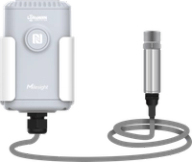
  • Motors, pumps, fans and gearboxes: A clamp-on vibration and temperature sensor such as the TWTG NEON. ISO 20816-3 gives guidance for judging vibration both by its level and by how much it changes, so each machine gets its own baseline.
  • Energy per line and per large consumer: Current clamps such as the Milesight CT105 on each line, compressor and chiller give the load profiles the audit asks for, without opening switchboards for a wired meter.
  • Compressed air: A pipe pressure sensor such as the Milesight EM500-PP plus the compressor's current, read outside shifts, measure the leak baseline before and after each repair campaign.
  • Work areas: Temperature, humidity and CO2 with a sensor such as the Milesight AM307, with alarms when a hall leaves the Royal Decree 486/1997 ranges.
  • What the PLCs already know: Run hours, stops, counters and alarms are read from the PLCs through the edge gateway over Modbus or OPC UA and sent by MQTT. No new sensor is needed for what the machine already measures.

Connecting it without touching safety or opening the network

Wireless sensors are clamped or glued onto the machine and do not go into its control circuit. The gateway only reads from the PLC network and only opens outbound connections, so the plant network stays closed to the internet. That is how monitoring is added without changing how the machine is protected, which is what the Machinery Regulation cares about; whether any change counts as substantial is still decided by the plant's own risk assessment.

For NIS2 and the Cyber Resilience Act, every supplier of connected equipment is part of your supply chain, us included. The data can stay in AWS Frankfurt or on your own servers, and alerts can open work orders in the maintenance software through the API.

How to plan a pilot

  • 1. Pick the machines that hurt most when they stop: The bottleneck of the line, the ones without a spare and the ones that have already failed this year.
  • 2. Read what already exists: PLC data and existing meters first; sensors only where there is no data.
  • 3. Learn each machine's normal for a few weeks: Then set alarms on the change against that baseline, not on a generic number.
  • 4. Turn alerts into work orders and records: Each alert that ends in a check leaves the documented record Royal Decree 1215/1997 asks for.

What to ask a provider

  • Does it read my PLCs without writing to them?: Read-only integration keeps the machine's safety as it was.
  • Where is the data and can I get it out?: The audit and the equipment checks need years of history; it has to be yours and reachable through an API.
  • How does it handle vulnerabilities?: The Cyber Resilience Act makes manufacturers report actively exploited vulnerabilities from September 2026. Ask every supplier how they do it.
  • Does it promise compliance?: No platform makes a machine or a plant compliant. It provides the measured record; competent staff, auditors and the authority decide.

Cloud Studio IoT runs in AWS (Frankfurt for Europe) or on your own servers, and under your brand if you are an integrator. Tell us about your plant.

Sources

  1. Royal Decree 1215/1997 on work equipment (BOE)
  2. Royal Decree 56/2016 on energy audits (BOE)
  3. Directive (EU) 2023/1791 on energy efficiency
  4. Regulation (EU) 2023/1230 on machinery
  5. Directive (EU) 2022/2555 (NIS2)
  6. Regulation (EU) 2024/2847 (Cyber Resilience Act)
  7. Siemens and Senseye, The True Cost of Downtime 2024
  8. Compressed Air Challenge, fact sheet 7: leaks

Industry 4.0 IoT: Frequently Asked Questions

Everything you need to know about implementing IoT in manufacturing

Get Started

Start your Industry 4.0 journey

Transform manufacturing with Cloud Studio IoT.