
Skip to main content

With IoT, there's no room for Waste

Boost efficiency in waste management with our platform. Optimize resources, reduce costs, and embrace a more sustainable future.

With IoT, there's no room for
40%

Reduction in collection costs

30%

Improvement in recycling rates

50%

Carbon footprint reduction

35%

Efficiency improvement in routes

25%

Reduction in overflow incidents

45%

Citizen satisfaction increase

Not optional

What the law and the lenders already ask of this kind of installation.

  • Required by lawSpain Law 7/2022 on waste and contaminated soils, article 25: separate collectionBio-waste since 2022 in municipalities above 5,000 inhabitants and since 2024 in the rest; textiles, oil, hazardous and bulky waste since 31 December 2024.
  • Required by lawSpain Law 7/2022, article 11.3: specific waste fee and pay-as-you-throwDue by 10 April 2025.
  • Required by lawDirective 2008/98/EC (Waste Framework Directive) as amended by Directive (EU) 2018/851
  • Required by lenders and insurersDelegated Regulation (EU) 2021/2139 (EU Taxonomy), activities 5.5 and 5.10Applies whenever a bank, fund or bond reports taxonomy alignment.
What each rule requires
01
Collection cost reduction
40%

Collection cost reduction

02
Recycling improvement
30%

Recycling improvement

03
Environmental impact reduction
50%

Environmental impact reduction

Smart Cities
01

Smart Cities

Municipalities transform waste management with IoT, achieving significant cost savings and environmental benefits.

Commercial Complexes
02

Commercial Complexes

Large facilities optimize waste handling while improving sustainability metrics.

Complete Waste Management Solutions

Smart waste management for cleaner, more efficient cities.

Fill Level Monitoring

Real-time monitoring of container fill levels.

Collection Planning

Fill-level data to plan collection routes.

Analytics Dashboard

Comprehensive waste generation and collection analytics.

Recycling Tracking

Monitor and improve recycling program effectiveness.

Smart Alerts

Notifications for overflow, contamination, or maintenance needs.

Asset Tracking

Track vehicles, containers, and equipment.

Regulations and certifications

What is required by law, what lenders and insurers ask for, and what is optional, with how continuous monitoring helps document it. The platform supports compliance; it does not certify it.

Required by law

Rules in force for the buildings and operators in their scope. Not meeting them can bring inspections, fines or loss of a licence.

  • Required by lawSpainLaw

    Spain Law 7/2022 on waste and contaminated soils, article 25: separate collection

    Article 25; sanctions in articles 108 and 109

    What it requires: Councils collect paper, metal, plastic, glass, bio-waste, textiles, cooking oil, household hazardous waste and bulky waste separately, giving priority to door-to-door or closed or smart containers. Improper material in bio-waste may not exceed 20%, and 15% from 2027, checked with periodic characterisations. At least 50% of municipal waste must be collected separately by 2035.

    Applies: Bio-waste since 2022 in municipalities above 5,000 inhabitants and since 2024 in the rest; textiles, oil, hazardous and bulky waste since 31 December 2024.

    If it is not met: Fines up to 2,000 euros if minor, 2,001 to 100,000 if serious and 100,001 to 3.5 million if very serious, higher for hazardous waste; a very serious sanction also bars public contracts.

    How monitoring helps: Fill level, temperature and lid or tilt sensors per fraction, with GPS on the trucks, give a dated record of every container: how full it was, when it was emptied and on which route. They do not measure improper material, which still needs manual characterisation.

    Official source
  • Required by lawSpainLaw

    Spain Law 7/2022, article 11.3: specific waste fee and pay-as-you-throw

    Article 11, sections 3 to 5

    What it requires: Councils must charge a specific, differentiated fee that is not in deficit, reflects the real cost of collection, transport and treatment, and allows pay-as-you-throw systems, and must send the fee and its calculation to the region.

    Applies: Due by 10 April 2025.

    How monitoring helps: Emptying counts, fill levels and route kilometres per container feed the cost calculation. Charging each household also needs identified bins or access-controlled containers and a billing system.

    Official source
  • Required by lawSpainLaw

    Royal Decree 646/2020 on landfill disposal

    Articles 8, 15 and 16; Annex III

    What it requires: During operation, leachate volume and landfill gas are checked monthly, leachate composition quarterly and groundwater level every six months (more often if it fluctuates), with at least one well upstream and two downstream. Adverse effects are notified without delay and results reported at least yearly. Aftercare lasts at least 30 years. By 2035 no more than 10% of municipal waste may be landfilled.

    Applies: In force; landfill limits of 40% in 2025, 20% in 2030 and 10% in 2035.

    How monitoring helps: Level in leachate ponds and sumps, groundwater level in piezometers, gas where certified sensors are used and a weather station give continuous data and alarms between campaigns. Sampling by an accredited body and laboratory analysis are still required.

    Official source
  • Required by lawEuropean UnionLaw

    Directive 2008/98/EC (Waste Framework Directive) as amended by Directive (EU) 2018/851

    Articles 11, 20 and 22

    What it requires: Separate collection of paper, metal, plastic, glass, textiles, bio-waste and household hazardous waste, and municipal waste prepared for reuse or recycled at 55% by 2025, 60% by 2030 and 65% by 2035.

    If it is not met: The European Commission listed Spain among the Member States at risk of missing the 2025 target and far from the 2035 landfill limit.

    How monitoring helps: Operational data per fraction to show progress. Official recycling rates come from the treatment plants, not from container sensors.

    Official source
  • Required by lawSpainLaw

    Royal Decree 1055/2022 on packaging and packaging waste

    Articles 32, 34 and 47

    What it requires: Councils collect household packaging separately, and the producer responsibility schemes must pay all the costs councils actually bear for it, transfer stations included. If the collection targets are missed, a deposit-return scheme becomes mandatory.

    Applies: In force since 29 December 2022.

    How monitoring helps: Emptying counts, fill levels and route kilometres for the packaging fraction support the cost the council claims; the formula is set in the agreement with each scheme.

    Official source
  • Required by lawUnited StatesLaw

    40 CFR Part 258 (municipal solid waste landfills) and Part 60 Subpart XXX

    §258.23, §258.54, §258.61; §60.763 and §60.765

    What it requires: Methane below 25% of the lower explosive limit in buildings and below it at the boundary, checked at least quarterly; groundwater monitored at least twice a year; 30 years of aftercare. Landfills with gas collection check negative pressure and temperature below 55 °C at each wellhead every month.

    Applies: In force.

    How monitoring helps: Continuous pressure and temperature at the wellheads and fixed methane sensors in buildings with alarms. The surface sweep still needs a portable analyser.

    Official source

Required by lenders, insurers and investors

Not a legal duty for the owner, but it decides financing terms, insurance or the value of the asset.

  • Required by lenders and insurersEuropean UnionLaw

    Delegated Regulation (EU) 2021/2139 (EU Taxonomy), activities 5.5 and 5.10

    Annex I, 5.5 collection of non-hazardous waste in separated fractions; 5.10 landfill gas capture

    What it requires: Separate collection counts as green when the fractions go to reuse or recycling and are not mixed in storage or transfer. Landfill gas capture counts on landfills closed since July 2020, with methane emissions and leaks monitored as the Landfill Directive requires.

    Applies: Applies whenever a bank, fund or bond reports taxonomy alignment.

    If it is not met: No penalty: without the evidence, the fleet or the gas plant cannot be financed as a green asset.

    How monitoring helps: Collection records per fraction and continuous gas, pressure and temperature data from the capture system are evidence for the alignment file; we do not certify alignment.

    Official source
  • Required by lenders and insurersEuropean UnionGuideline

    EU green public procurement criteria for road transport, waste collection services

    Categories 5 (waste trucks) and 6 (waste collection services), SWD(2019) 2

    What it requires: Recommends that contracting authorities explore route optimisation, including sensors inside the bins that report fill level in real time, which the document credits with fuel savings of 5% to 15%.

    If it is not met: Voluntary criteria; written into a tender, they decide the award.

    How monitoring helps: Fill level per container and GPS per truck are the data a route optimisation needs.

    Official source

Waste collection and landfills: what Law 7/2022 and the landfill rules ask councils and operators to measure

Since Law 7/2022, a Spanish council has to collect up to nine fractions separately, charge a fee that covers the real cost of the service and move toward pay-as-you-throw, while the landfill tax and the landfill limits make every tonne that is not recycled more expensive. Landfills, for their part, must monitor leachate, gas and groundwater for at least 30 years after closure. This guide explains what each rule asks for, which data answers it and what container and landfill sensors cannot do.

What the rules require from the council

Law 7/2022 requires separate collection of paper, metal, plastic, glass, bio-waste, textiles, cooking oil, household hazardous waste and bulky waste, and tells councils to prioritise door-to-door collection or closed or smart containers. Improper material in bio-waste may not exceed 20%, and 15% from 2027. Since April 2025 the waste fee must be specific, cover the real cost and allow pay-as-you-throw. Fines go up to 3.5 million euros for very serious breaches, which also bar the offender from public contracts.

The targets are hard. Spain recycled 42.5% of its municipal waste in 2024 against an EU average of 49.4% and a 2025 target of 55%, and it landfilled almost half of what it generated, with legal limits of 40% in 2025 and 10% in 2035. The European Commission listed Spain among the Member States at risk on both.

ObligationRuleData that answers it
Separate collection by fractionLaw 7/2022, art. 25Fill level and emptying per container and fraction
Fee that covers the real costLaw 7/2022, art. 11Emptyings, kilometres and route time
Packaging costs paid by producersRD 1055/2022, art. 34The same data for the packaging fraction
Leachate, gas and groundwater controlRD 646/2020, Annex IIIPond level, piezometers, gas where certified

Landfills: 30 years of monitoring

Royal Decree 646/2020 asks for leachate volume and landfill gas every month during operation, leachate composition every quarter and groundwater level every six months, more often if it fluctuates, with at least one well upstream and two downstream. Adverse effects are notified without delay and aftercare lasts at least 30 years. Sampling must be done by an accredited body and analysed in an accredited laboratory: sensors do not replace that, but they show what happens between campaigns.

Fires are the other risk. The US EPA counted 245 fires caused by lithium batteries at 64 waste facilities between 2013 and 2020 and considers the figures severely underreported. A temperature sensor inside the container or in the bunker gives early warning; it is not a fire detection system.

What to measure

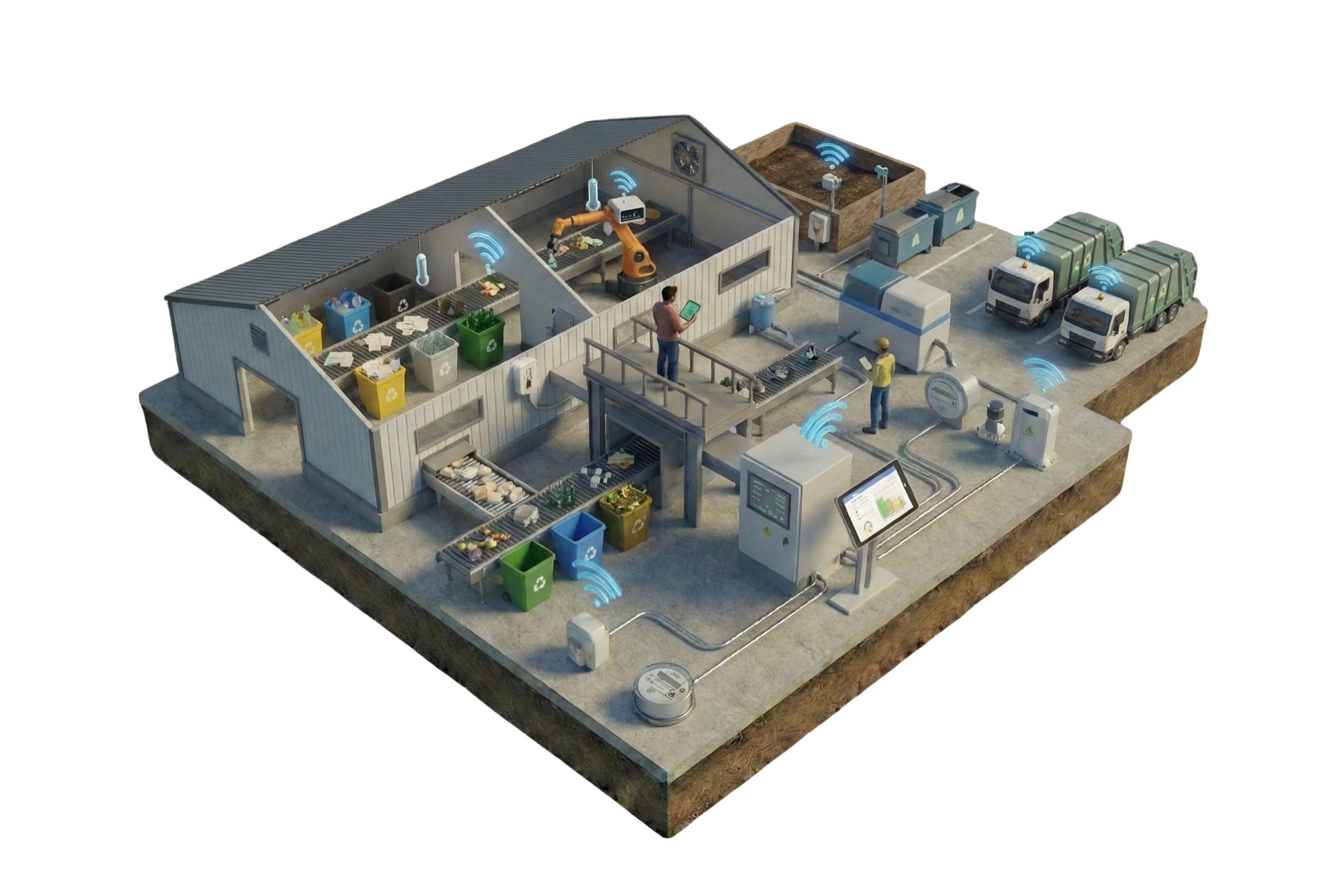
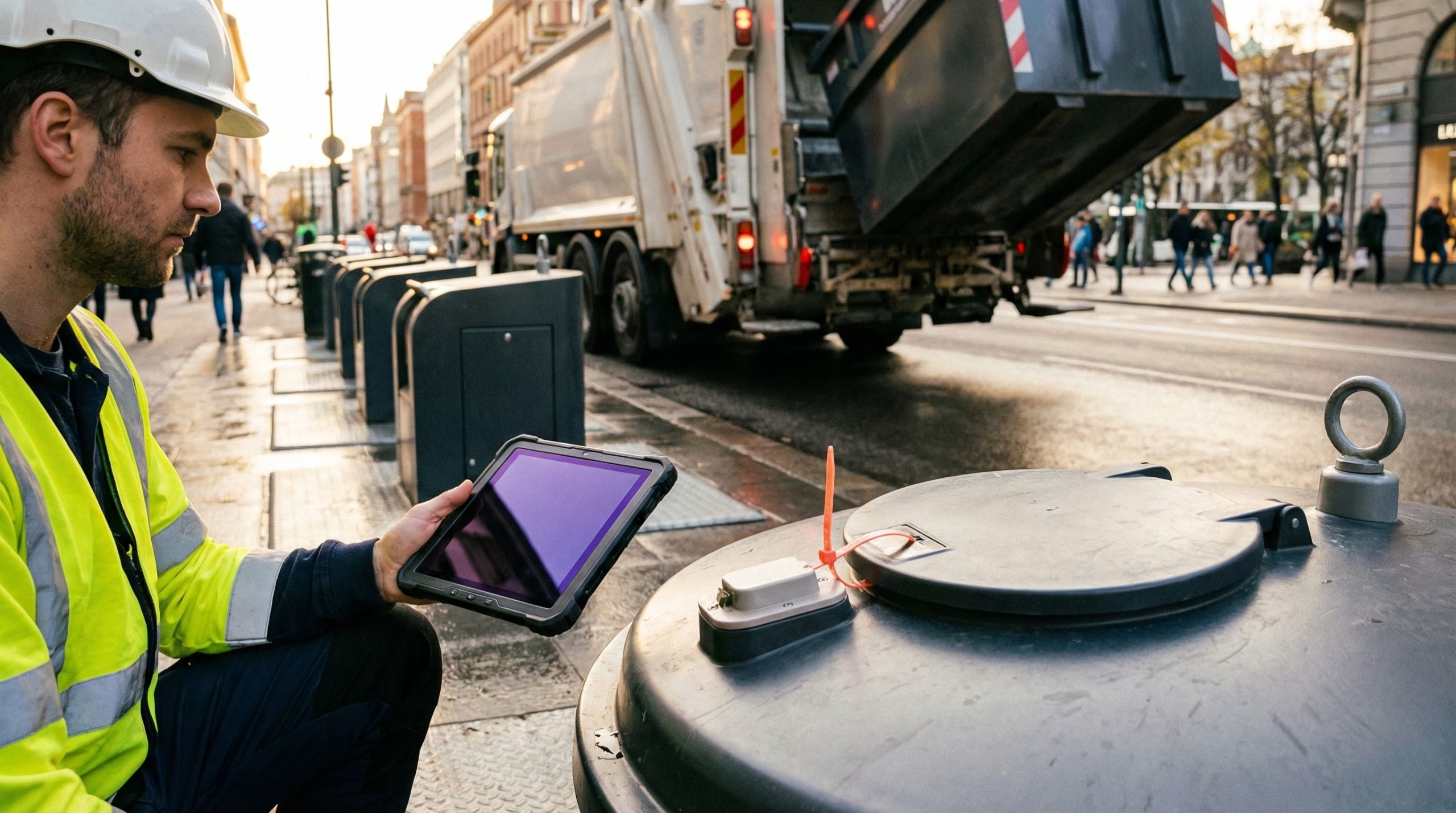
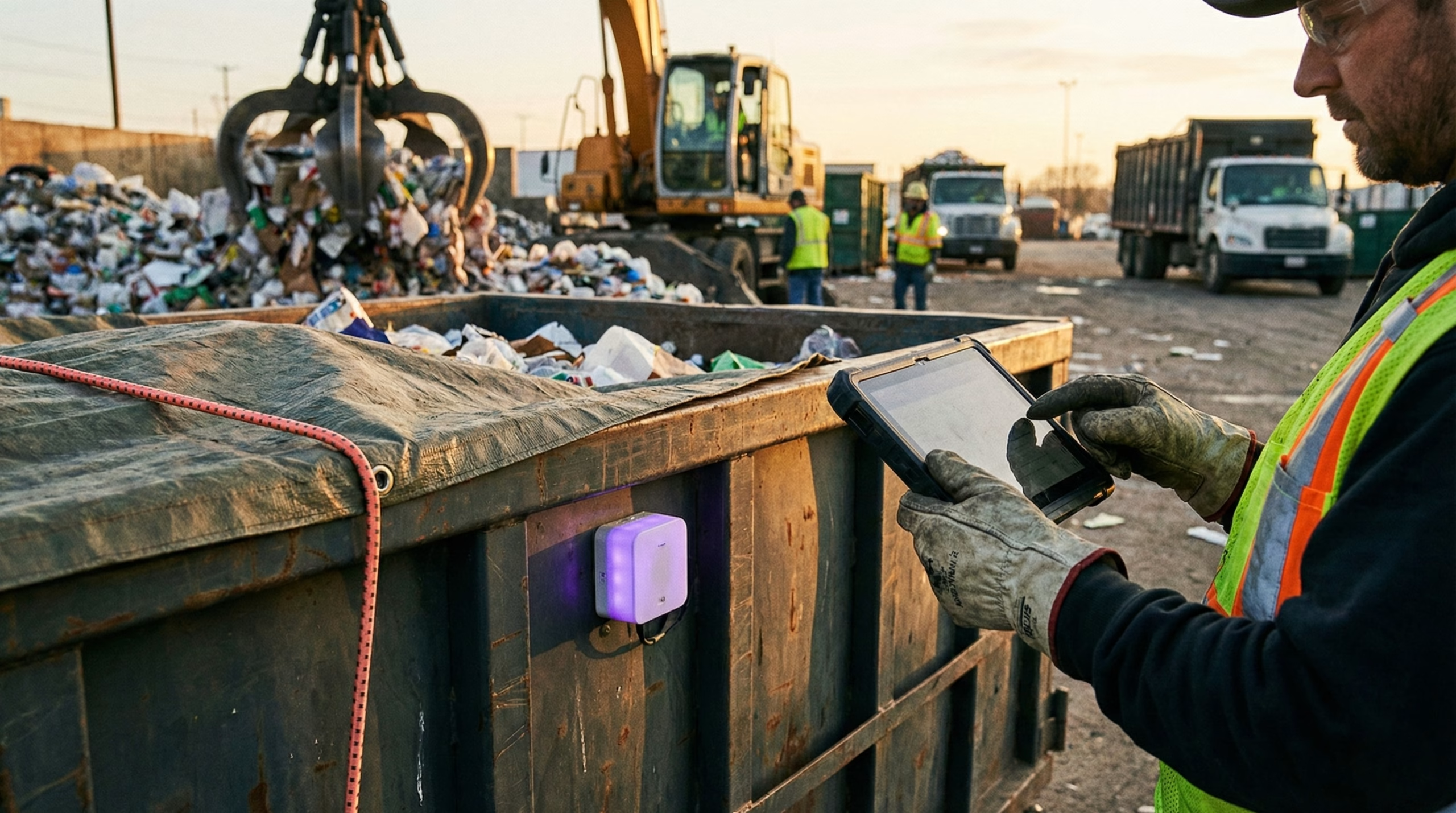
  • Containers: Fill level and temperature with sensors such as the Milesight EM310-UDL or the Dingtek DF555, per fraction, to empty when needed and keep the record of each emptying.
  • Trucks: GPS and emptying counts per route give the kilometres and time behind the fee and the packaging cost claim.
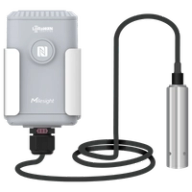
  • Leachate and groundwater: Level in ponds and sumps, and groundwater level in the piezometers with a submersible sensor such as the Milesight EM500-SWL, with alarms between sampling campaigns.
  • Gas and weighbridges: Gas in buildings and at the perimeter only with certified sensors; wellhead pressure and temperature and the weighbridge readings come in through the edge gateway. The certified weighbridge remains the base of the landfill tax.

Limits: fill sensors do not measure improper material or identify households, and metal or underground containers weaken the radio signal. Landfill sensors do not replace the accredited sampling and laboratory analyses.

How to plan a pilot

  • 1. One fraction, one district: Bio-waste or packaging in the district with the most overflowing complaints.
  • 2. Compare routes with and without data: Kilometres, emptyings and containers emptied half full, before and after.
  • 3. Use the data for the fee and the packaging claim: The same history supports the real cost calculation.
  • 4. Add the landfill or the transfer station: Leachate, piezometers and bunker temperature in the same platform.

Cloud Studio IoT runs in AWS (Frankfurt for Europe) or on your own servers, and under your brand if you are a collection concessionaire or an integrator. Tell us about your service.


Sources

  1. Law 7/2022 on waste (BOE)
  2. Royal Decree 646/2020 on landfills (BOE)
  3. Royal Decree 1055/2022 on packaging (BOE)
  4. Eurostat, recycling rate of municipal waste
  5. European Commission, early warning report COM(2023) 304
  6. US EPA, lithium-ion battery fires at waste facilities

Waste Management IoT: Frequently Asked Questions

Everything you need to know about implementing IoT in waste management

Get Started

Build a cleaner future

Smart waste management for sustainable cities.