

提醒与警报
The Gear Studio platform 允许您 define alerts that trigger when the values of certain variables exceed defined thresholds. 警报, on the other hand, are conditions that indicate a problem and can occur for different reasons, including alerts. In other words, alerts generate alarms when measured values fall outside established thresholds, but alarms can also be generated for other reasons, such as device malfunctions, connection errors, etc.
提醒
提醒 are applied to endpoints and allow you to define acceptable value ranges so that alarms are automatically generated when values fall outside these thresholds. To set up an alert, use the alerts screen, w此处 you 选择 the alert type, the endpoint it will apply to, the threshold value, and optionally, a minimum duration the condition must persist before the alert generates the corresponding alarm.
Normal Value
It is also possible to define a second threshold for the alert to clear. This allows establishing a hysteresis value to prevent the alert from triggering frequently when the endpoint value fluctuates near the threshold. For example, you can set a high temperature alert with the threshold at 60 degrees and a normal threshold of 55. This will cause the alert to trigger when the value exceeds 60 degrees and clear only when the temperature drops to 55 degrees. The alert will remain active from the time the temperature exceeds 60 degrees until it drops to 55.
提醒 Severity
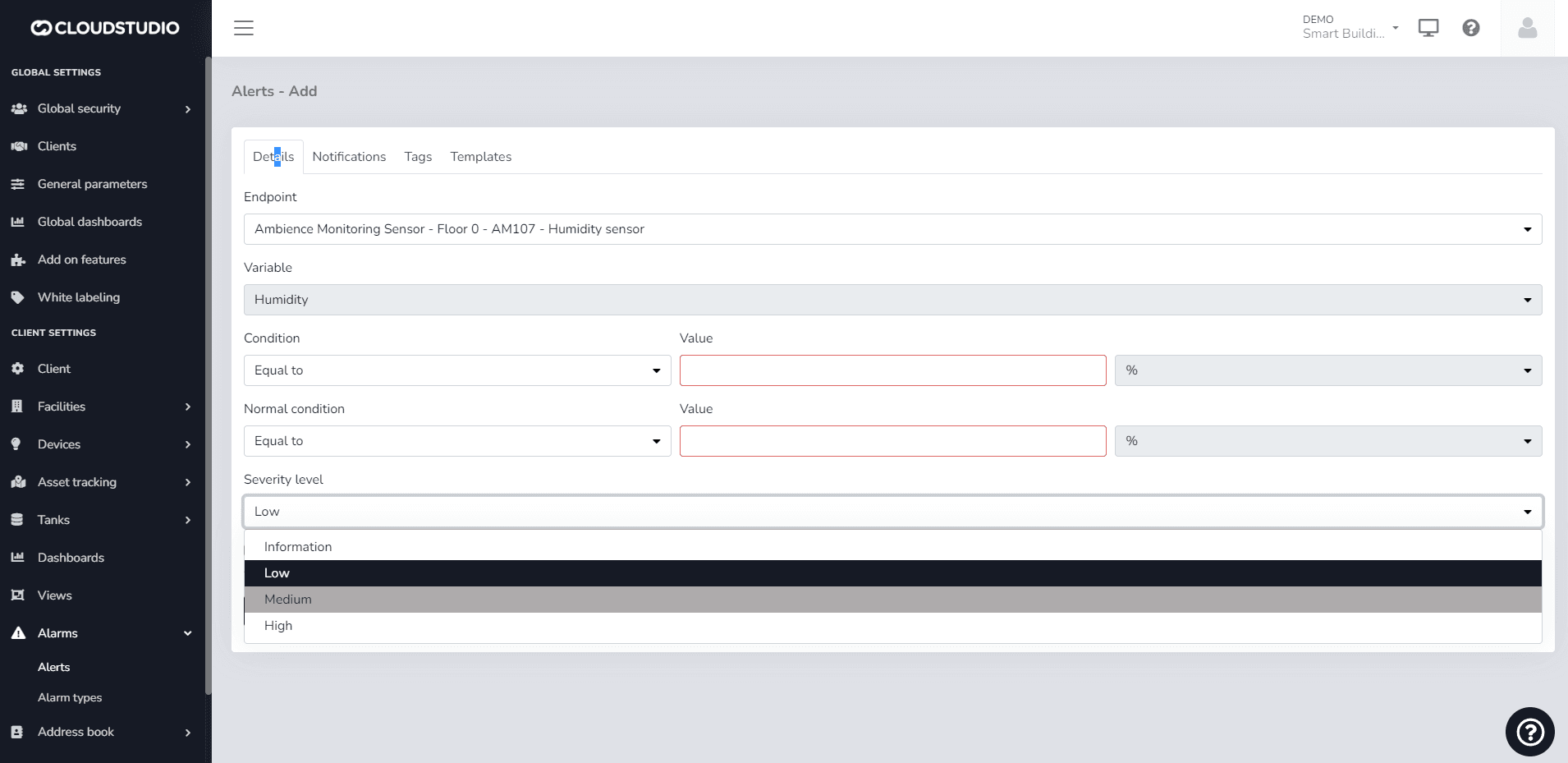
Severity levels in alerts indicate the criticality associated with alarms. Severity levels can be information, low, medium, or high as shown in the following image:
重要说明
By default, an alarm will be created with the "Low" value. If an alert is created with a severity level of "High", for example, and that alert is subsequently triggered, the alarm history report will retain the severity level with which it was created, even if the severity level was later modified through the alert settings.
Available 提醒 Types
The following are the alert types available on the platform, with a brief explanation of each.
| Variable | Condition | Supports normal threshold | Supports minimum duration |
|---|---|---|---|
| Temperature | High or low | Yes | Yes |
| Humidity | High or low | Yes | Yes |
| Light level | High or low | Yes | Yes |
| Volume | High or low | Yes | Yes |
| Weight | High or low | Yes | Yes |
| 按下ure | High or low | Yes | Yes |
| Voltage | High or low | Yes | Yes |
| Current | High or low | Yes | Yes |
| Active power | High or low | Yes | Yes |
| Reactive power | High or low | Yes | Yes |
| Apparent power | High or low | Yes | Yes |
| Cosine phi | High or low | Yes | Yes |
| IAS sensor | Activated or deactivated | No | Yes |
| Generic variable | High or low | Yes | Yes |
提醒 配置
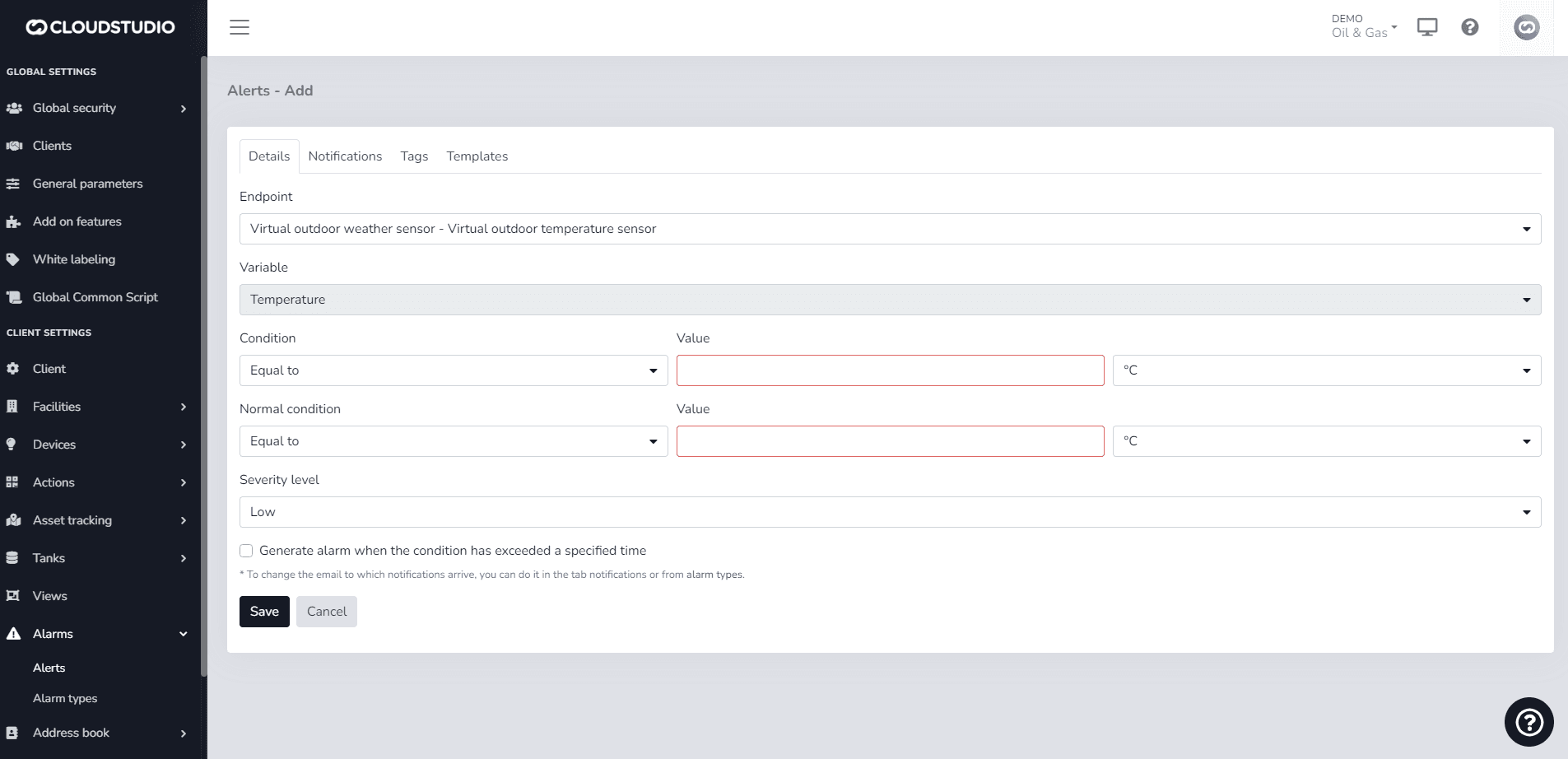
提醒 are applied to endpoints and allow you to define acceptable value ranges so that alarms are automatically generated when values fall outside these thresholds. To set up an alert, use the alerts screen, w此处 you 选择 the alert type, the endpoint it will apply to, the threshold value, and optionally, a minimum duration the condition must persist before the alert generates the corresponding alarm.
用户 can use all available variables that have been enabled in their instance and can also customize alert subjects.
For additional information about the allowed variables, 点击 此处
These are the allowed parameters (Variables):
| Variable | 说明 |
|---|---|
| {CLIENT_ID} | Unique client identifier |
| {CLIENT_NAME} | Client name/description |
| {FACILITY_ID} | Unique facility identifier |
| {FACILITY_NAME} | 设施 description |
| {DEVICE_ID} | Unique device identifier |
| {DEVICE_NAME} | Device description |
| {ENDPOINT_ID} | Unique endpoint identifier |
| {ENDPOINT_NAME} | 端点 description |
| {DEVICE_OR_ENDPOINT_NAME} | 端点 description. If not valid, the device description will be shown. |
| {ALARM_TEXT} | 警报 description |
| {ALARM_DETAILS} | 警报 details |
警报
警报 are triggered automatically when problems are detected with devices, endpoints, alerts, or any other anomalous situation. The most common alarm types are shown 下方.
| 警报 type | 说明 |
|---|---|
| Device offline | 触发器ed when a device does not communicate with the platform after a certain time. The maximum time a device can go without sending information to the platform is set in each device model. |
| 提醒 | 触发器ed when an alert indicates that an endpoint value is outside the defined thresholds. For each alert type, t此处 is a corresponding alarm type, for example, high temperature alarm, IAS sensor activation alarm, etc. |
| Low battery | 触发器ed when a device's battery level is low. |
| Critical battery | 触发器ed when a device's battery level is critical. |
| Overheating condition. All outputs turned off | This alarm type is not yet implemented |
| Low temperature condition | This alarm type is not yet implemented |
| Charging failure | This alarm type is not yet implemented |
| Informational message | This alarm type is not yet implemented |
| Unspecified or generic message | This alarm type is not yet implemented |
最后更新于