Protocols

Zigbee
Veteran 2.4 GHz mesh — backbone of many smart home hubs
Official spec ↗Zigbee
Executive summary
- The Zigbee protocol is a low-power wireless mesh-network specification based on the IEEE 802.15.4 radio standard, maintained by the Connectivity Standards Alliance (CSA) — the same body that governs Matter.
- It operates mainly in the 2.4 GHz band (global) and, in some regions, at 868 MHz (Europe) and 915 MHz (the Americas).
- Its strength is the mesh topology: every mains-powered device (a router) relays traffic, extending coverage without additional infrastructure. It supports up to 65,000 nodes per network.
- Very low power: a battery sensor can last years because it sleeps between transmissions (end device) while the routers keep the mesh alive.
- It's the protocol behind millions of Philips Hue, IKEA Trådfri, Aqara, SmartThings, and Sonoff devices, and the most common RF foundation behind Matter.
- Current version: Zigbee 3.0 (2016) unified the previous profiles (Home Automation, Light Link) into a single application layer.
- Don't use it when: you need high bandwidth (video, audio), long point-to-point links without intermediate nodes (use LoRaWAN), or you want direct IP connectivity without a gateway.
What Zigbee is and what it's for
Zigbee is a short-range, low-power wireless-network specification designed for home automation, light industrial control, and sensors that send small amounts of data intermittently. If you want to put Zigbee in the context of the broader ecosystem, read what IoT is first. It has existed since 2003 and is one of the most mature IoTITermIoT (Internet of Things)The IoT (Internet of Things) is the network of physical objects with sensors, software and connectivity that collect and exchange data and act autonomously.View profile protocols on the market.
It's worth separating two layers that people often confuse:
- IEEE 802.15.4 is the standard for the physical layer (PHY) and medium access control (MAC): it defines how the radio is modulated and how the channel is shared. It's the same thing that Thread and, partly, Matter use underneath.
- Zigbee adds the network layer (mesh routing) and the application layer (clusters, device profiles) on top. That's what turns a raw radio into a light bulb that understands "turn on at 50%."
Unlike MQTT, which is a messaging protocol over TCP/IP, Zigbee is a complete network stack from the physical layer to the application layer. It doesn't speak IP natively: it needs a coordinator/gateway to translate between the Zigbee mesh and your home network or the cloud.
How Zigbee works
Node types
A Zigbee network has three roles:
| Role | Function | Power |
|---|---|---|
| **Coordinator (ZC)** | Creates and governs the network, assigns addresses, manages security. There is exactly one. | Always powered |
| **Router (ZR)** | Relays messages from other nodes (extends the mesh) and operates as a device. | Always powered |
| **End Device (ZED)** | A leaf of the network: it only talks to its parent node and can sleep to save battery. | Battery |
The coordinator is usually your gateway (a Philips Hue Bridge, a SmartThings Hub, or a USB dongle running Zigbee2MQTT). Plugged-in bulbs and sockets act as routers; battery-powered door or temperature sensors are end devices.
Mesh topology
This is where Zigbee's real value lies. If the coordinator is far from a sensor, the message hops from router to router until it arrives:
[Battery sensor] → [Bulb router] → [Socket router] → [Coordinator/Gateway] → IP networkThe more mains-powered devices you have, the more robust and extensive the network becomes. If a router goes down, the mesh recalculates the route automatically (self-healing). This contrasts with Wi-Fi, where everything hangs directly off the router.
Addressing and clusters
Each node receives a 16-bit network address. The application layer organizes functionality into clusters (On/Off, Level Control, Color Control, Temperature Measurement…) grouped into endpoints. This cluster model is the direct ancestor of Matter's data model — which is why both share DNA.
Security
Zigbee 3.0 encrypts traffic with AES-128. There are two keys: the network key (shared across the whole mesh) and optional link keys per device pair. Pairing uses an install code or the legacy "Trust Center Link Key" method. The historical weak point was pairing: older versions transmitted the network key with a well-known key during the join.
Real-world use cases
| Sector | Concrete example |
|---|---|
| **[Smart home](/en/use-cases/smart-home)** | Philips Hue, IKEA Trådfri, Aqara, and Sonoff Zigbee. The Home Assistant + Zigbee2MQTT + Sonoff dongle stack is the most widespread DIY setup. |
| **Smart buildings** | Occupancy sensors, thermostats, and lighting control in offices, where the mesh covers entire floors without wiring. |
| **Retail** | Electronic shelf labels (ESLs) and environmental sensors in supermarkets. |
| **Light industry** | Condition monitoring (temperature, humidity) in warehouses and cold-chain operations. |
| **Energy** | Some smart meters and submetering systems use Zigbee (the Smart Energy profile). |
When NOT to use Zigbee
- You need high bandwidth: Zigbee delivers 250 kbps gross at 2.4 GHz. Forget about video, audio, or frequent heavy OTAOTermOTA (over-the-air)OTA (over-the-air) is the remote update of an IoT device's firmware over the network, without physical access, essential for large fleets.View profile firmware.
- Long links without intermediate nodes: the per-hop range is 10-100 m. For kilometers, use LoRaWAN or NB-IoT
 ProtocolNB-IoT3GPP-standardized cellular LPWAN — carrier coverageView profile.
- You want native IP: Zigbee needs a gateway. If you want every device to be addressable by IPv6 without a translator, look at Thread.
- Critical coexistence with saturated Wi-Fi: the 2.4 GHz band is crowded. In dense-Wi-Fi environments you have to choose Zigbee channels carefully (15, 20, and 25 usually dodge the common Wi-Fi channels).
Zigbee compared with the alternatives
Zigbee competes in the short-range, low-power mesh space. Against Wi-Fi, it wins on power consumption and node count, but loses on bandwidth and needs a gateway. Against Bluetooth Low Energy (BLE), Zigbee has a more mature mesh for fixed home automation, while BLEBTermBluetooth Low Energy (BLE)Bluetooth Low Energy (BLE) is the low-power variant of Bluetooth, for sending small amounts of data intermittently with minimal battery. It dominates wearables and proximity. Maintained by the Bluetooth SIG.View profile dominates wearables and smartphone proximity. Against Thread, its cousin based on the same 802.15.4 radio, Zigbee has a much larger installed ecosystem, but Thread brings native IPv6 and is the future Matter is pushing.
| Aspect | Zigbee | Wi-Fi | BLE Mesh | Thread |
|---|---|---|---|---|
| Base radio | IEEE 802.15.4 | IEEE 802.11 | Bluetooth LE | IEEE 802.15.4 |
| Topology | Mesh | Star | Mesh | Mesh |
| Power draw | Very low | High | Very low | Very low |
| Bandwidth | 250 kbps | 100+ Mbps | 1-2 Mbps | 250 kbps |
| Native IP | No (gateway) | Yes | No | Yes (IPv6) |
| Max nodes | ~65,000 | ~250 | thousands | ~250+ |
| Ecosystem maturity | Very high | Total | Medium | Growing |
Zigbee and Matter: the end of Zigbee?
It's the question of the moment. Matter uses Thread and Wi-Fi as transport, not Zigbee. But the CSA governs both, and many gateways (SmartThings, Aqara, Amazon Echo) act as a bridge: they expose existing Zigbee devices to Matter. Zigbee won't disappear in the short term — hundreds of millions of devices are deployed — but new high-end hardware is trending toward Thread/Matter. For new projects in 2026, the Zigbee vs Thread decision depends on whether you prioritize a mature, cheap ecosystem (Zigbee) or an IP-native future (Thread). For the full technical comparison, see the Zigbee vs Matter vs Thread comparison.
Getting started: Zigbee with Home Assistant and Zigbee2MQTT
The most popular DIY path combines a USB coordinator (a Sonoff Zigbee 3.0 Dongle Plus, based on a Texas Instruments CompanyTexas InstrumentsAnalog and embedded semiconductors (MSP430, INA2xx)View profile or Silicon Labs chip) with Zigbee2MQTT, which translates the Zigbee mesh into MQTT topics that Home AssistantHTermHome AssistantHome Assistant is an open-source home automation platform focused on local control and privacy, with broad integration support.View profile can consume.
1. Spin up Zigbee2MQTT with Docker
docker run -d \
  --name zigbee2mqtt \
  --device=/dev/ttyUSB0 \
  -v $(pwd)/data:/app/data \
  -e TZ=Europe/Madrid \
  koenkk/zigbee2mqtt
2. Configure the bridge to the MQTT broker
# data/configuration.yaml
mqtt:
  server: mqtt://localhost:1883
serial:
  port: /dev/ttyUSB0
permit_join: false   # enable it only during pairing
3. Pair a device
Temporarily enable permit_join from the Zigbee2MQTT UI and put the device into pairing mode (usually a long press). It will appear publishing to topics like:
zigbee2mqtt/sensor_livingroom → {"temperature":21.5,"humidity":48,"battery":92}From there, any MQTT ProtocolMQTTThe standard pub/sub protocol of IoTView profile consumer (Home Assistant, Node-REDNTermNode-REDNode-RED is a flow-based visual programming tool to wire together devices, APIs and services, widely used in automation and IoT.View profile, your own backend) receives the telemetry. You've turned a proprietary mesh into standard data.
Pros and cons
Pros
- Self-healing mesh: extensible, resilient coverage without wiring.
- Minimal power draw: battery sensors last years.
- Huge ecosystem: thousands of interoperable Zigbee 3.0-certified devices.
- Cheap: low-cost chips and devices, plenty of competition.
- Mature: 20+ years of real-world deployments.
Cons
- Requires a gateway: it isn't IP-native; you depend on a coordinator.
- Saturated 2.4 GHz band: coexistence with Wi-Fi requires channel planning.
- Imperfect interoperability: a "Zigbee 3.0 certificate" doesn't guarantee that every exotic vendor feature works on another hub.
- Low bandwidth: no multimedia and no frequent heavy OTA.
- History of join-time security issues: older versions exposed the network key.
Primary sources
- Connectivity Standards Alliance — Zigbee — the body that maintains the standard (accessed: 2026-05)
- IEEE 802.15.4 standard — the base physical/MAC layer (accessed: 2026-05)
- Zigbee2MQTT — the reference open source project and compatible-device list
- Zigbee Specification (R23) — downloadable spec
Frequently asked questions
What is Zigbee and what is it used for?+
Zigbee is a low-power wireless mesh-network protocol based on IEEE 802.15.4, used mostly in home automation (lighting, sensors, sockets) and building control. It lets hundreds of devices form a self-healing, low-power mesh.
Is Zigbee better than Wi-Fi for home automation?+
For low-power sensors and actuators, yes: Zigbee uses far less battery, supports many more nodes, and forms a mesh. Wi-Fi wins when the device needs bandwidth (cameras) or a direct IP connection without a gateway.
Does Zigbee work with Matter?+
Not directly: Matter uses Thread and Wi-Fi, not Zigbee. But many hubs (SmartThings, Aqara, Echo) act as a bridge and expose your Zigbee devices to Matter. Existing Zigbee hardware stays useful.
How many devices does a Zigbee network support?+
Theoretically up to 65,000 nodes per network, although in practice home gateways handle dozens or hundreds. The real limit is set by the number of routers (mains-powered devices) holding up the mesh.
What's the range of Zigbee?+
Between 10 and 100 meters per hop, depending on the environment and power. The mesh topology extends that range by hopping from router to router, so total coverage depends on how many mains-powered devices you have distributed.
Is Zigbee secure?+
Zigbee 3.0 encrypts traffic with AES-128. The historically weak point was the pairing process in older versions. In modern deployments with install codes, it's reasonably secure for home use.
Compatible devices
- nRF52840, Silicon Labs EFR32MG, Texas Instruments CC2652
Related hardware

Related articles

IoT Sensors: Types, Protocols and Applications in 2026
IoT sensors convert physical-world measurements — temperature, gases, vibration, light, position — into continuous, actionable, scalable digital data. This guid
Jul 9, 2026

From Iceland to Buenos Aires: How Smart Lighting and IoT Are Reshaping Cities Worldwide
Smart street lighting is an advanced system that uses sensors, connectivity, and intelligent controls to adapt lighting based on real-time conditions like traffic flow, weather, or human presence. These systems integrate LED technology for energy efficiency, durability, and longe
Apr 15, 2026

Symbio: Real-Time Water Safety with Clams and IoT
Symbio Project: Living Sensors for Clean Water In an extraordinary fusion of biology, environmental science, and IoT technology, the Symbio project, developed in Poland, introduces an innovative method for real-time monitoring of drinking water quality using freshwater mollusks,
Apr 1, 2026
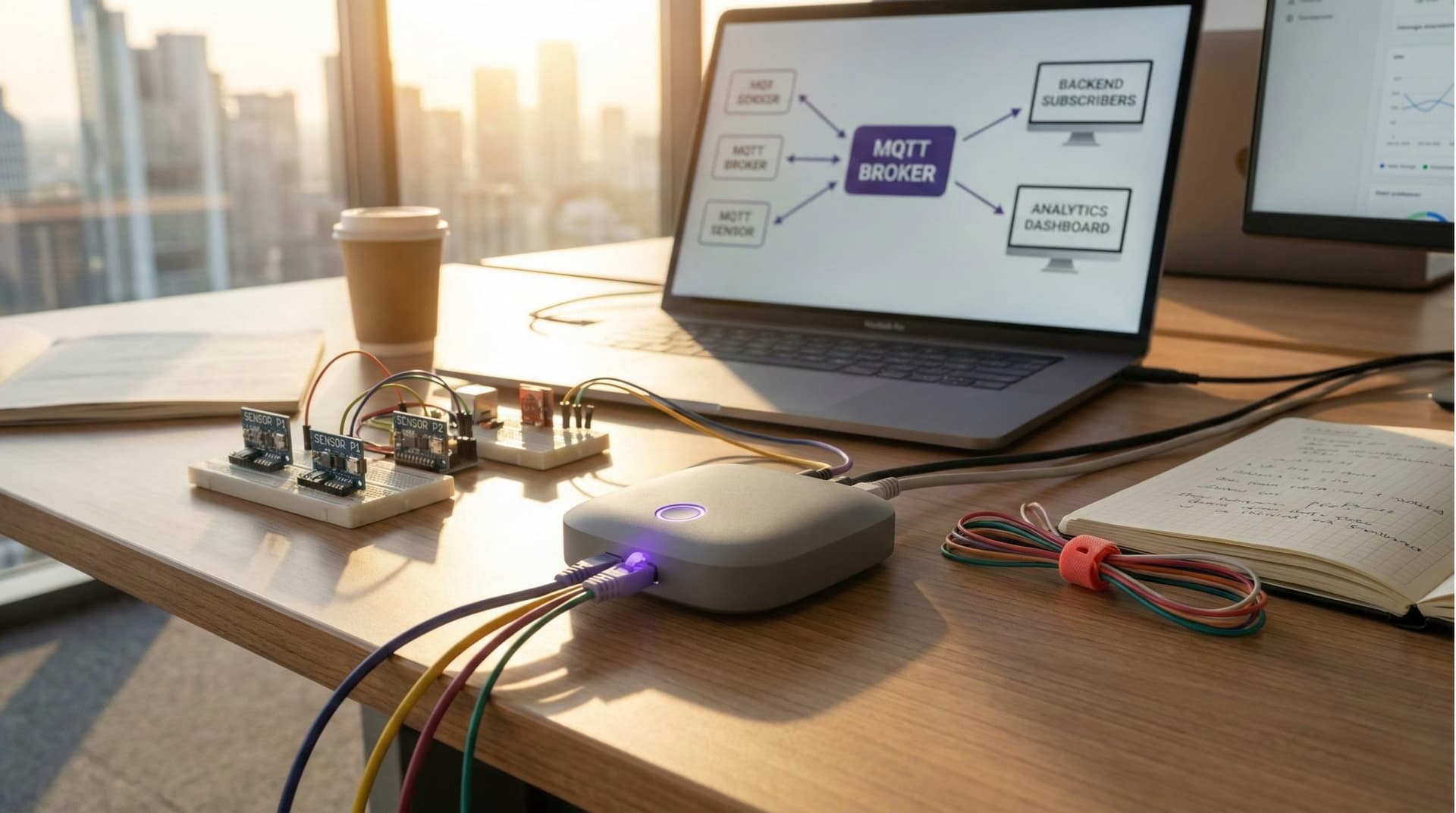
MQTT vs CoAP vs HTTP for IoT: Ultimate Protocol Comparison Guide
Choosing between MQTT vs CoAP vs HTTP for an IoT deployment is one of the most consequential technical decisions an engineering team will make. The protocol you select determines how efficiently your devices communicate, how much battery they consume, and whether your architectur
Feb 16, 2026
Did You Know IKEA Uses IoT? ZigBee and the Smart Home Revolution
IKEA uses ZigBee 3.0 for its smart home ecosystem. We explain the "invisible IoT", architecture, security, mesh networks and industrial parallels.
Sep 1, 2025
What Is LoRaWAN & How Does It Work? (2026 Guide)
A complete 2026 guide to how LoRaWAN works — architecture, device classes (A/B/C), range, security, real-world use cases and how it compares to NB-IoT and Sigfox.
Apr 28, 2025